2026 MacJannet Prize Winners
About the Winners:
First Place: Project Luminary (Parami University, Myanmar)
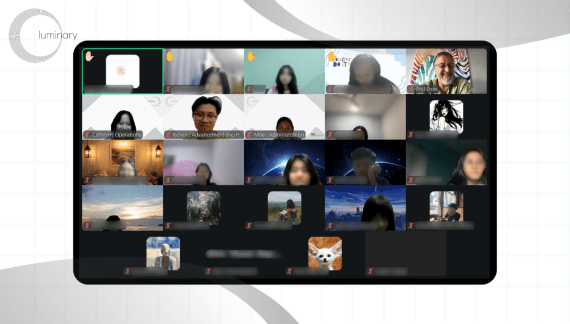
In response to the 2021 Myanmar military coup, which displaced an estimated 12 million learners from formal schooling and led to a near-total collapse of the education system, Project Luminary was founded to empower underserved Burmese youth affected by political instability, socio-economic disadvantage, and educational inequality. Refusing to let a "lost generation" become its legacy, the project provides free, structured programmes that combine higher education access, skills building, and critical social engagement. Project Luminary’s mission is anchored on two core objectives:
-
- To equip youth with the tools, skills, and knowledge necessary to successfully navigate the higher education landscape
- To cultivate critical awareness of social issues that contribute to their intellectual growth and civic responsibility.
In December 2024, Project Luminary's pilot programme empowered 40 youth to develop essential university application skills and engage in discussions on critical social issues. In January 2025, they also launched the Lumina Academic Research Consortium, where 20 youth received training in research design and methodology and engaged in practical research projects funded by Project Luminary. Learn more.
Second Place: En Libertad de Educación or ELEDUC (Pontificia Universidad Católica de Chile, Chile)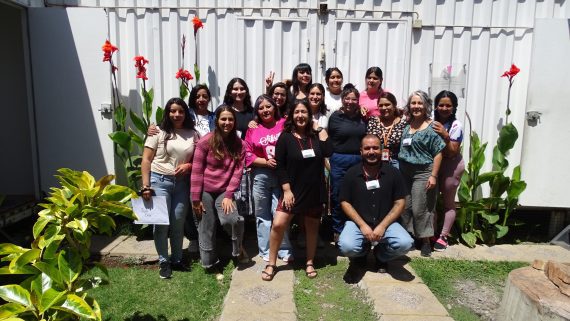
The “En Libertad de Educación” (ELEDUC) program prepares, supports, and accompanies incarcerated women in Chile through public challenges—primarily educational inequality, social exclusion, lack of employable skills, and mental health challenges—so they can enter and remain in higher education and strengthen their educational and professional pathways.
The “En Libertad de Educación” (ELEDUC) program seeks to prepare, support, and accompany women who are currently or have previously been deprived of liberty so they can enter and remain in higher education, strengthening and supporting their educational and professional pathways. ELEDUC addresses several public challenges affecting incarcerated women in Chile, primarily educational inequality, social exclusion, lack of employability skills, and mental health challenges. Chile has the second-largest female prison population in Latin America, making this an urgent issue. With the conviction of contributing to their social reintegration through the development of their strengths, the program works through three stages:
- Academic learning opportunities, vocational exploration, and transversal skills development to prepare participants for higher education.
- Retention in higher education through a comprehensive support approach that reduces the likelihood of dropping out of the educational process.
- Labor market insertion and employment support.
Currently, the program works with 50 participants: 26 in Stage One and 24 in Stage Two. By the end of 2026, the graduation of five participants is projected, representing a major milestone and creating the need to further strengthen Stage Three, focused on workforce integration. Learn more.
Third Place: Frontliner Model (American University of Beirut, Lebanon)
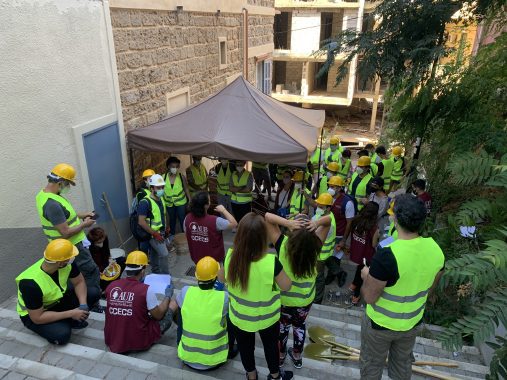
The Frontliner Model—a combination of strategic community initiatives reaching 40,000 direct beneficiaries; an Engaged Scholars Program with scholarships, volunteering rotations, internships, and workshops for students totaling over 200,000 hours; and a core curriculum course Fundamentals in Community Engagement taken by over 800 students—incorporates theoretical, classroom-based knowledge with practical skills and an ethical orientation to address pressing challenges in crises ridden landscapes and raise exceptional, civically engaged “wounded healers.” The Frontliner Model aims for higher education institutions to incorporate theoretical, classroom-based knowledge with practical skills and an ethical orientation to address pressing challenges in crises ridden landscapes. The Frontliner Model has a strong successful track record under its three components:
- Strategic Community Initiatives: over the past decade, CCE has reached approximately 40,000 direct beneficiaries through high-impact, multi-year interventions designed to empower the most vulnerable populations across Lebanon. These flagship projects focus on education, livelihood, and mental health.
- Engaged Scholars Program: over the past decade, 4,871 students engaged in 16,029 volunteering rotations, completing a total of 144,942 hours; 564 students interned with community-based organizations, fulfilling 52,077 hours; 3,775 students participated in community engagement skills workshops. In addition, 195 Community Engagement Projects were designed and/ or implemented by 706 students across Lebanon, Sub-Saharan Africa, Afghanistan, and the MENA region. These projects reached over 6,000 beneficiaries and addressed some of the most pressing challenges ranging from wars, gun violence, drug abuse, reconstruction, gender-based violence, natural disasters, food safety and the right to education.
- Fundamentals in Community Engagement: CCE launched a three-credit Community Engaged Learning course as part of AUB’s core General Education curriculum and more than 800 students have enrolled in its 2025 inaugural year of implementation, with 99% completion rate. Learn more.
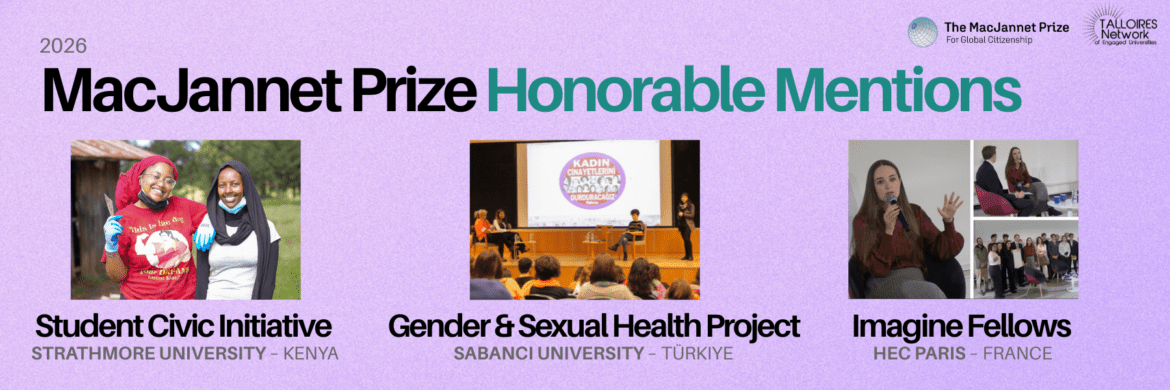
About the Honorable Mentions:
Student Civic Initiative (Strathmore University, Kenya)
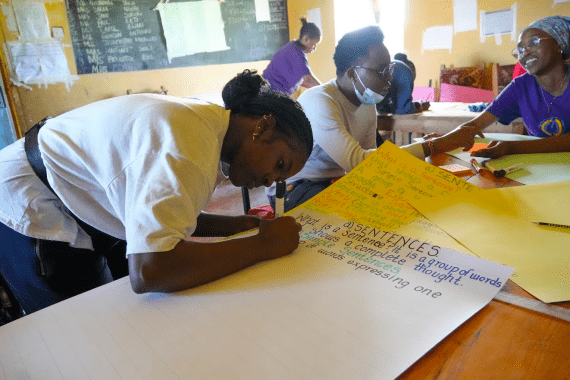 The Student Civic Initiative focuses on improving the facilities of public primary schools, enhancing educational outcomes, and restoring the local environmental ecosystems in the marginalised rural Kenya. Leadership roles are held by a team of 25 Law School students in a given academic year; more students support the leading team by contributing individually 50 shillings daily, totaling 250 shillings per week, which amounts to 7000Ksh throughout the semesters.
The initiative started in 2022 and has so far run four successful work camps to renovate Enengeetia Primary School in Mau, Narok County; plant trees and carry out monthly tuition in support of the Junior Secondary School Learners to prepare them for the national examinations. Students have: repaired 15 classrooms; dug a well and connected an electrical pump and filtering system; installed electricity in all classrooms, staff room, and the school compound; provided internet access and a printer; financed tuition; tutored 500 junior secondary school (grade 7, 8, and 9) with a 90% transition rate to high school; provided exercise books to 36% of students in the school every year since 2023; and provided all the reference books for English, Mathematics and Kiswahili subjects for the Junior Secondary School teachers. Learn more.
Gender and Sexual Health Project (Sabanci University, Türkiye)
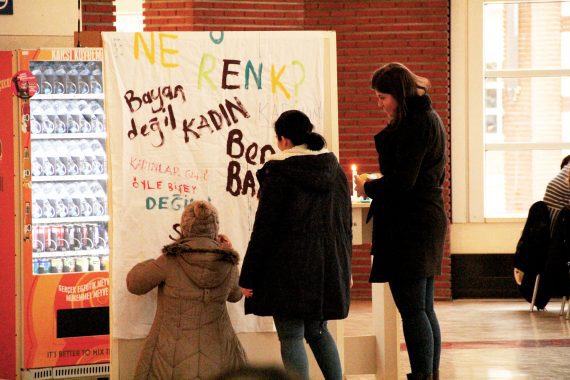 In a context where Turkish women regularly face violence, discrimination, limited access to accurate sexual health information, and unequal participation in decision-making processes, Gender and Sexual Health Project raises awareness, educates, and encourages active participation on gender-based discrimination, gender-based violence, access to accurate health information, consent, healthy relationships, and sexual rights, impacting 1,100 students since its inception in 1999.
The mission of Civic Involvement Projects (CIP), including its Gender and Sexual Health Project, is to foster socially responsible and engaged citizens by combining student leadership, community partnership, and evidence-based approaches. The program aims to raise awareness, promote education, and encourage active participation in addressing pressing social issues such as gender equality, sexual and reproductive health, and social inclusion. Since its founding in 1999, this project has raised awareness among students on the relevant issues and to promote informed decision-making processes. Although the project is organized within a university unit (the CIP Office at Sabanci University), it is implemented by students, and the project content is designed and carried out by them. The primary focus areas of the project include gender-based discrimination, gender-based violence, access to accurate health information, consent, healthy relationships, and sexual rights. These issues are particularly significant in the Turkish context, where challenges such as violence against women, discrimination, limited access to accurate sexual health information, and unequal participation in decision-making processes continue to affect individuals and communities. Since 1999, an average of 1,100 students have participated, with approximately 100 serving as project supervisors each year. Learn more.
HEC Imagine Fellows program (HEC, France)

The Imagine Fellows Program brings exceptional students from war-torn countries (including Afghanistan, Syria, Sudan, Belarus, and Ukraine) to HEC Paris to become world leaders harnessing education and business as forces for peace at major platforms such as Paris Peace Forum, ChangeNOW, UNESCO sessions, and audiences with the French Ministry of Foreign Affairs—receiving 14 Business & Peace ambassador certificates from the French Ministry for Europe and Foreign Affairs.
The HEC Imagine Program aims to harness education and business as forces for peace by supporting exceptional students from war-torn countries and equipping them to become responsible global leaders. Through the different program components like: scholarships, inclusive learning environments, and academic and community initiatives focused on Business & Peace and Human Rights, the program fosters resilience, dialogue, and cross-cultural understanding. To date, the program has supported 20 Fellows from several conflict-affected countries (including Afghanistan, Syria, Sudan, Belarus, and Ukraine) to access graduate education at HEC Paris, strengthened campus integration and peer-to-peer solidarity, and enabled student-led engagement through 15+ peace-focused events. Fellows and students have organized events reaching hundreds of participants and have represented the initiative on major platforms such as the Paris Peace Forum, ChangeNOW, and sessions hosted at UNESCO. Fellows have also shared their perspectives at high-level venues, including the French Ministry of Foreign Affairs, contributing to discussions on business, human rights, and conflict. The program has supported tangible initiatives, including raising €1,500 for earthquake relief in Afghanistan and awarding 14 Business & Peace ambassador certificates (March 2024, French Ministry for Europe and Foreign Affairs). Learn more.