How Youth-led Participatory Action Research Locally Grounded a Global Cohort
Tuesday, February, 24th, 2026 Inaugural Cohort Case Studies
Before joining the Youth-led Participatory Action Research (YPAR) Working Group, many participants were already responding to social challenges around them—investigating health disparities, coordinating environmental projects, or organizing community initiatives. What they lacked was a shared language and framework for understanding their work as research. The movement’s curriculum on YPAR introduced them to a methodology rooted in collaboration, curiosity, justice, and community ownership, allowing them to see their efforts as part of a broader tradition of youth-led inquiry.
At Makerere University, Tyobo Harriet Yake had been working with a multidisciplinary student team designing a locally made orthopedic table and an AI system for early hypertension detection. Her work required hospital visits, ethics approvals, patient interviews, and careful coordination of coders, designers, and medical advisors. Harriet had long been practicing the principles of participatory research without naming them as such. When she encountered YPAR for the first time, she realized that what she had been doing intuitively, centering community voices, iterating based on lived realities, and adapting quickly, was part of a rich scholarly tradition grounded in action.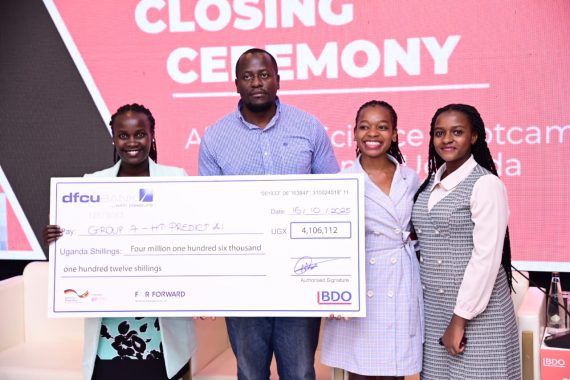 Harriet and her team celebrating their award-winning hypertension prediction project — a powerful example of youth-led research driving community-centered innovation.
At the University of Pretoria, Kamvelihle Mapundu coordinated a student-driven beekeeping project in a rehabilitated garden. She and her peers had no prior experience, but they had curiosity. Week after week, they learned through trial and error, consulting zoology faculty about infestations, watching global beekeeping videos, sourcing cow dung from a campus farm, and documenting their progress. The working group helped Kamvelihle name this process as research and recognize that knowledge was being co-produced not only in classrooms but in gardens, conversations, and community spaces.
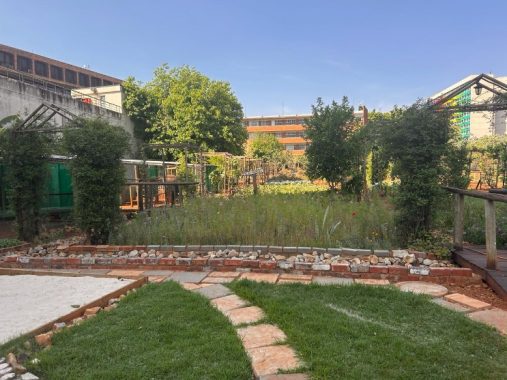 The rehabilitated garden at the University of Pretoria, where Kamvelihle and her peers built their student-led beekeeping project through curiosity, collaboration, and community-rooted research.
In the working group sessions, students facilitated discussions, reflected on case studies, and drafted a booklet explaining YPAR in accessible language. As they spoke about their projects, they recognized the expertise they already possessed. One student said that by the midpoint of the program, participants realized they “knew more about it than they thought they did.” That recognition was transformative. For many, it was the first time they saw themselves as researchers, not just volunteers or problem-solvers. Through these cross-border conversations, students practiced a form of conscious leadership rooted in humility and shared purpose, strengthening a sense of global solidarity as they learned from one another’s community realities.
YPAR also reshaped how students thought about partnership. Harriet noted that her team’s medical prototype could only succeed if communities were fully involved in designing and testing it. Kamvelihle observed that the success of her beekeeping project depended not on her enthusiasm alone but on listening, adjusting, and trusting others. Their reflections illuminated the heart of YPAR: research that is collaborative, relational, deeply local, and oriented toward action.
As a form of public scholarship, the stories emerging from the YPAR Working Group highlight how youth can strengthen community–university partnerships and produce knowledge that matters. Their work contributes to ongoing conversations about health equity, environmental sustainability, and participatory learning. The booklet they drafted, and the reflections they shared, now form part of the movement’s evolving knowledge base. They provide future cohorts—and educators across institutions—with examples of how youth-led research can illuminate social challenges and catalyze institutional change.
In sharing these stories, the students demonstrated that research is not an abstract or distant practice. It is grounded in relationships, in the willingness to ask questions and listen deeply, and in the courage to take action. Their work shows how young people, when supported and trusted, can lead inquiries that strengthen communities and reshape universities. Through YPAR, they came to see themselves not simply as students within institutions but as researchers contributing to their transformation.