Designing Everything That Comes Next: Youth Leading Responsible AI and Imagining New Futures for Higher Education
Tuesday, February, 24th, 2026 Inaugural Cohort Case Studies
Students entered the Responsible AI and Future of Higher Education working groups with varied backgrounds, some grounded in technology, others in leadership, disability advocacy, or community service. What united them was a sense of urgency about the systems shaping their lives and a desire to contribute meaningfully to the future. The working groups offered them a space to explore ethical challenges surrounding artificial intelligence, question the role of universities in society, and imagine new models for learning and partnership. In the movement’s curriculum, Responsible AI is not taught as a technical specialization but as an ethical, social, and communal inquiry. Similarly, the Future of Higher Education group invites young people to see themselves as contributors to institutional change.
At Makerere University, Byansi Anthony arrived with experience working at the disability support center, where he developed digital tools for visually impaired students. Although he understood the technical aspects of accessibility, the working group helped him see the broader ethical dimensions of AI: how infrastructure, cost, and global disparities affect who benefits from technological innovation.
For Catherina Ngongni Kuetezang, a bioinformatics student at the University of Pretoria, ethical AI was inseparable from community well-being. She founded an AI literacy society to address misconceptions on campus and co-founded a nonprofit serving refugee children and underserved communities. Participating in the working group deepened her insight that AI is most impactful when it emerges from local realities and when young people shape its design.
Some participants, like Makerere University’s Joel Kirabo, entered with strong leadership backgrounds rather than technological expertise. Joel facilitated conscious leadership workshops in high schools, helping students explore self-awareness, conflict resolution, and accountability. For him, the ethical questions surrounding AI felt familiar: they echoed the values he had been teaching—responsibility, empathy, and clarity of intention.
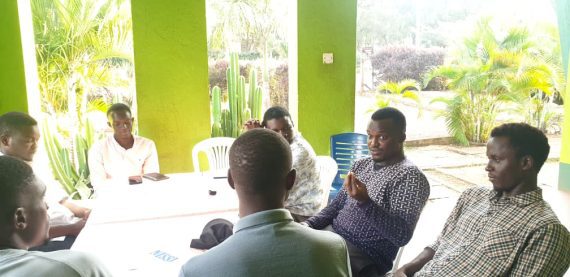 A leadership circle facilitated by Joel, where students explored self-awareness, responsibility, and the values that guide ethical decision-making
The Responsible AI sessions explored global inequalities in data and energy infrastructure and asked students to consider who AI is built for, who it excludes, and what responsibilities developers carry. Students acted as Ministers of Energy designing national AI strategies with limited resources. They learned from global experts and grassroots organizations, gaining a holistic understanding of AI’s environmental, political, and human implications. Working alongside peers from different countries, the students approached these questions with a spirit of conscious leadership and global solidarity, recognizing that ethical innovation requires both self-awareness and shared responsibility across borders.
These discussions set the stage for collective design work. Participants collaborated to prototype a mentorship-matching platform for the movement—an exercise that helped demystify AI and position students as creators rather than consumers of technology. Joel, focusing on interface design, gained a new appreciation for how user experience shapes ethical outcomes. Catherina learned how to guide a team through technical and moral decision-making. Together, they co-authored policy briefs on responsible AI infrastructure and digital inclusion, which they later presented at the Istanbul Youth Conference, where university leaders and policymakers engaged with their ideas.
While this work unfolded, the Future of Higher Education group explored what a more just and community-engaged university system could look like. Students gathered insights from university administrators, community-engaged scholars, and fellow youth leaders to draft the 2025 Declaration on the Future of Higher Education. They spoke with honesty about the challenges students face—financial exclusion, limited belonging, the distance between curriculum and community—and considered how universities might respond. Students like Lucky Buhlebodwa Geluk brought their experience from campus residences and creative communication work, helping ensure that the declaration reflected both institutional realities and student voices.
The working groups were not without challenges. The volume of interviews, the complexity of synthesizing global insights, and the responsibility of drafting policy recommendations demanded significant commitment. But these challenges became opportunities for shared leadership, patience, and collaboration—values central to the For Youth, By Youth movement.
Through their efforts, the students demonstrated how youth can shape responsible technology and influence institutional thinking. Their prototypes, policy briefs, and educational declarations are early contributions to the movement’s five-year knowledge base—materials that will guide future cohorts and help educators understand the power of youth-led inquiry.
In imagining what comes next for AI and higher education, these young leaders did more than critique systems; they began designing new ones. Their work reminds us that ethical innovation is not merely technical—it is relational, reflective, and hopeful. Through their leadership, they illuminated how young people can participate fully in redefining the purposes of universities and the responsibilities of emerging technologies. Their contributions will continue to inform the movement and inspire others seeking to build more just and inclusive futures.
Read the 2025 Talloires Network Declaration on the Future of Higher Education.